When people think of Spain’s historic World Cup victory, their minds usually leap straight to mesmerizing passing sequences and endless possession. But behind the midfield magic lies a tactical truth that was just as crucial to their glory: unmatched tactical compactness.
Spain didn’t just dominate with the ball—they controlled the space without it. By minimizing the distances between their defensive, midfield, and attacking lines, Spain choked off opponents’ passing lanes, suffocated counter-attacks, and rendered traditional attacking strategies useless.
Here is a breakdown of how Spain’s defensive and positional compactness powered them to world football’s ultimate prize.
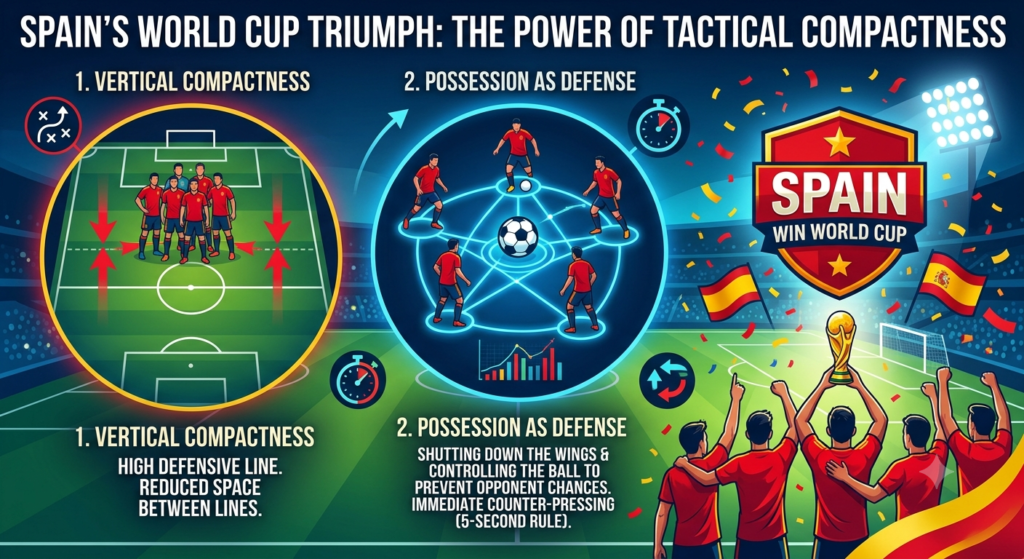
1. The High Line and Vertical Compression
Spain’s compactness started from the back. Rather than retreating into a deep defensive shell, their backline pushed high up the pitch, compressing the vertical space available to opponents.
- Shrinking the Pitch: By keeping no more than 25–30 meters between their forward line and center-backs, Spain effectively played the match in half the pitch.
- Denying Space Between the Lines: Opposing attacking midfielders—who usually thrive in the pocket between midfield and defense—found zero breathing room.
2. Possession as the Ultimate Defensive Shield
Compactness is often associated with defending, but for Spain, it was fundamentally tied to their passing structure (Juego de Posición).
“If you have the ball, the opponent cannot score. If you lose it while standing close together, you win it back in seconds.”
Because Spain kept short distances between players while in possession, they were naturally structured to defend the instant they lost the ball.
- The 5-Second Rule (Counter-Pressing): When a pass was intercepted, three or four Spanish shirts immediately swarmed the ball carrier.
- Snapping Counter-Attacks: Because they were geographically compact on the pitch, they didn’t have to sprint 40 yards backward—they just took two steps forward and snuffed out the threat.
3. The Double-Pivot Anchor
At the heart of Spain’s defensive structure was the disciplined double-pivot pairing in midfield. Acting as the team’s connective tissue, they provided structural balance that allowed creative players to flourish while maintaining strict spatial control.
- Lateral Compactness: The double pivot shuffled side-to-side in harmony with the ball, ensuring Spain never got stretched wide across the midfield.
- Recycling and Rest Defense: While Spain pressed forward, the central midfielders and full-backs maintained a “rest defense” shape, ensuring that even during an attack, the defensive structure was never disorganized.
4. Cohesive Horizontal Movement
Compactness isn’t just vertical; it’s horizontal. Spain moved as a single, fluid unit across the width of the pitch.
| Defensive Phase | Tactical Behavior | Impact on Opponent |
|---|---|---|
| Wide Defense | The entire team shifted toward the flank where the ball was. | Trapped opponents against the touchline with no exit route. |
| Central Block | Midfielders forced play outward away from the dangerous center. | Denied high-value central passing corridors. |
| Transition | Immediate collapse around the ball carrier upon turnover. | Forces rushed errors and turnovers before a counter-attack starts. |
Summary: A Masterclass in Spatial Control
Spain’s World Cup glory proved that possession football and defensive firmness are two sides of the same coin. By staying compact, disciplined, and ridiculously tight in their distances, Spain turned the football pitch into a labyrinth with no exit for their opponents—securing their place in football history as one of the most complete teams ever assembled.