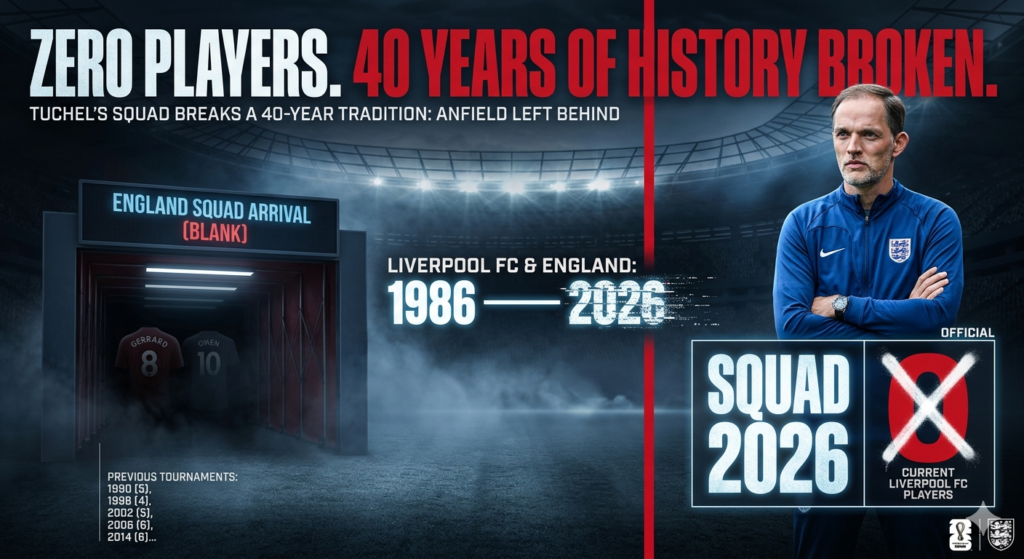
The official announcement of Thomas Tuchel’s 26-man England squad for the 2026 World Cup has sent shockwaves through English football. Beyond the massive individual casualties like Phil Foden and Cole Palmer, the most striking collective takeaway is the complete absence of a single Liverpool player.
According to statistical data from Opta, this marks the first time since the 1986 World Cup in Mexico—exactly 40 years ago—that England will head into a major international tournament without a single Liverpool representative.
The Historical Baseline
Liverpool has traditionally acted as the operational spine of the national team. To put this 40-year streak into perspective, Anfield has consistently supplied legendary foundational blocks across eras:
- 1990–2000s: Peter Beardsley, John Barnes, Michael Owen, Robbie Fowler, Steven Gerrard, Jamie Carragher.
- 2010s–2020s: Jordan Henderson, Raheem Sterling, Daniel Sturridge, Trent Alexander-Arnold.
The sudden drop to zero in 2026 represents a sharp, historic break in international squad dynamics.
Tactical Analysis: Why Are There Zero Reds?
The lack of Liverpool representation isn’t a random accident; it’s the byproduct of highly specific tactical profiling by Thomas Tuchel and shifting squad demographics at Anfield.
1. The Right-Back Hierarchy & The Trent Exile
The headline tactical choice of Tuchel’s tenure is the omission of Real Madrid-bound Trent Alexander-Arnold. Reports tracking the selection process revealed that Alexander-Arnold sat seventh on Tuchel’s right-back pecking order.
Tuchel heavily prioritizes natural defensive solidity and direct width over high-risk playmaker profiles in his back four. With Reece James (Chelsea), Tino Livramento (Newcastle), and Tottenham’s Djed Spence preferred, alongside central defenders like Ezri Konsa who can flex wide, Alexander-Arnold’s defensive profile simply did not fit the system.
2. The Midfield Bottleneck
Curtis Jones made the provisional training pool and featured in World Cup qualifying, but was ultimately cut from the final 26. He couldn’t displace the locked-in defensive pivot of Declan Rice and Kobbie Mainoo, nor could he edge past Jude Bellingham or tactical wildcards like Nottingham Forest’s Elliot Anderson and Aston Villa’s Morgan Rogers. Harvey Elliott similarly fell outside the tactical plans.
3. Exiles, Youth, and Foreign Demographics
The players with “Liverpool DNA” in the squad are either former players or academy prospects not yet in the first team:
- Jarell Quansah made the defensive cut, but he represents Bayer Leverkusen following his transfer.
- Jordan Henderson is on the plane for a record-equalling fourth World Cup, but he plays for Brentford.
- Liverpool teenager Rio Ngumoha is traveling, but only to assist in the pre-tournament Florida training camp—he is not in the official 26.
Furthermore, under Arne Slot, Liverpool’s current world-class spine is almost entirely foreign: Alisson (Brazil), Virgil van Dijk and Ryan Gravenberch (Netherlands), Alexis Mac Allister (Argentina), Dominik Szoboszlai (Hungary), and Mohamed Salah (Egypt).
Tuchel’s Blueprint: Chemistry Over Club Reputations
Tuchel’s squad selection proves he is actively dismantling the old “Big Six” bias that plagued previous England managers. Instead of relying on name recognition, his 26-man roster relies on modern profile matching and role clarity.
”Everything I know about international football… is that it is about chemistry. It is so obvious in this moment that teams win titles. In the end, it comes down to this—who do we really trust? The connection has to be there.” — Thomas Tuchel
By favoring reliable tactical fits like Dan Burn and recalling red-hot out-of-ecosystem strikers like Ivan Toney (Al-Ahli), Tuchel has built a functional, cohesive unit rather than an all-star collection.
When the Three Lions kick off their campaign against Croatia in Dallas on June 17, they will look entirely different than they have for the last four decades. For Liverpool, the silver lining is clear: a rare, completely uninhibited summer break for their domestic core before the 2026–27 Premier League campaign begins.