

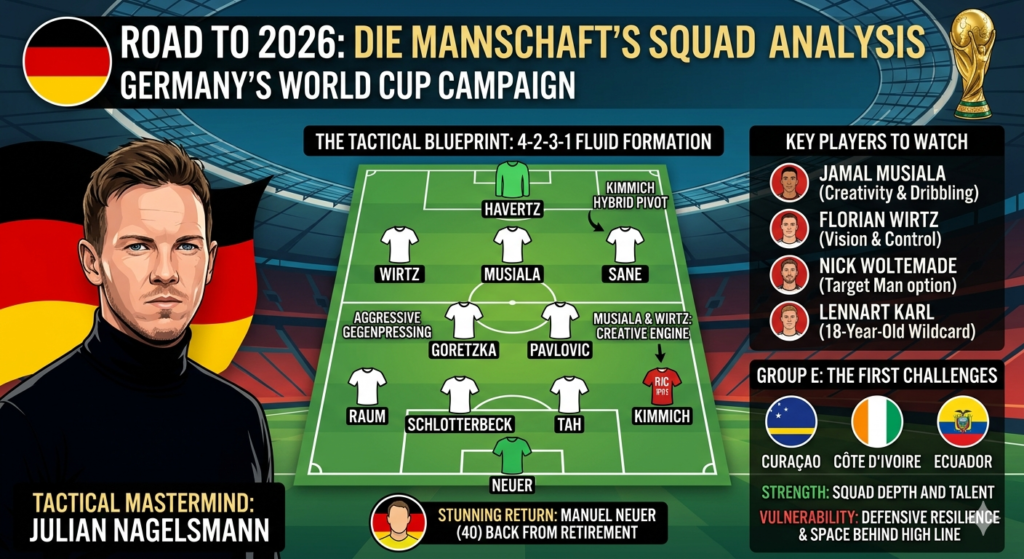
The 2026 FIFA World Cup marks a critical crossroads for the Germany national football team. After consecutive, humiliating group-stage exits in 2018 and 2022, Die Mannschaft heads to North America under the guidance of 38-year-old tactical mind Julian Nagelsmann.
Equipped with a highly scrutinized, intriguing 26-man roster, Germany is attempting to blend historic experience with a fearless new generation. Drawn into Group E alongside Curaçao, Côte d’Ivoire, and Ecuador, this tournament is about much more than surviving the group—it is about restoring Germany’s reputation as a ruthless global football powerhouse.
The Big Storyline: Neuer’s Stunning Return
The headline capturing everyone’s attention is the dramatic return of Manuel Neuer. The 40-year-old legendary goalkeeper reversed his international retirement just a month before the tournament.
While Nagelsmann has reliable options in Oliver Baumann and Alexander Nübel, Neuer’s presence injects iconic, 2014 World Cup-winning DNA into an otherwise transitional squad. The big risk? Relying on a 40-year-old keeper behind a backline that has shown vulnerability under pressure.
The Tactical Blueprint
Nagelsmann relies heavily on a fluid, intense 4-2-3-1 formation, though he has shown a willingness to shift into a 4-3-3 depending on the opponent.
Germany’s primary tactical identity rests on extreme verticality and aggressive counter-pressing (Gegenpressing). Rather than keeping sterile possession, Nagelsmann expects the full-backs to push incredibly high to overwhelm opposition lines. When building from the back, captain Joshua Kimmich often tucks inward from right-back to form a hybrid midfield pivot, allowing the left-back (likely David Raum) to function practically as a winger.
Roster Breakdown & Analysis
The Defense: Solidity vs. Space
With Kimmich deployed at right-back, the central defensive burden falls on Jonathan Tah and Nico Schlotterbeck (with Antonio Rüdiger serving as a high-profile, explosive option off the bench following recent recovery from injury).
- The Strength: Tah provides elite composure and masterclass tackling, which is vital because Nagelsmann’s high line leaves plenty of empty space behind.
- The Vulnerability: Kimmich’s defensive limits in one-on-one wide tracking could be heavily targeted by elite, pacey wingers.
The Midfield: The Engine Room Transition
The retirement of midfield metronome Toni Kroos leaves a massive structural void. Nagelsmann is leaning heavily into a Bayern Munich-centric engine room. Leon Goretzka brings physical box-to-box power, while young starlet Aleksandar Pavlovic or Dortmund’s Felix Nmecha are expected to handle deep ball progression.
The Attack: A Creative “Cheat Code”
The absolute crown jewel of this German squad is its line of attacking midfielders. Playing Jamal Musiala and Florian Wirtz together gives Germany unmatched creative trickery in tight half-spaces.
- The X-Factor: Keep a sharp eye on 18-year-old Bayern Munich prodigy Lennart Karl, who broke into the senior picture just in time to make the squad as a highly unpredictable wildcard.
- The No. 9 Dilemma: Germany lacks a traditional, clinical target-man in the mould of Miroslav Klose. Arsenal’s Kai Havertz will likely operate as a fluid, deep-lying forward. While brilliant at linking play, his clinical efficiency remains under the microscope. If Nagelsmann needs pure physical presence, he’ll turn to Newcastle’s towering 6’6″ striker Nick Woltemade.
Tournament Outlook
Historically, German football prided itself on Soldatenfußball (soldier football)—a resilient, disciplined style characterized by the famous saying: “You haven’t beaten a German team until their bus has left the stadium parking lot.”
The 2026 iteration is vastly different. It is highly technical, immensely creative, and intensely modern, but it lacks the steel of previous generations. If Wirtz and Musiala hit their stride, and Neuer finds his old magic, Germany has the squad depth to play deep into July. However, if their high-pressing structure gets exposed on the counter, another early exit isn’t entirely off the table.