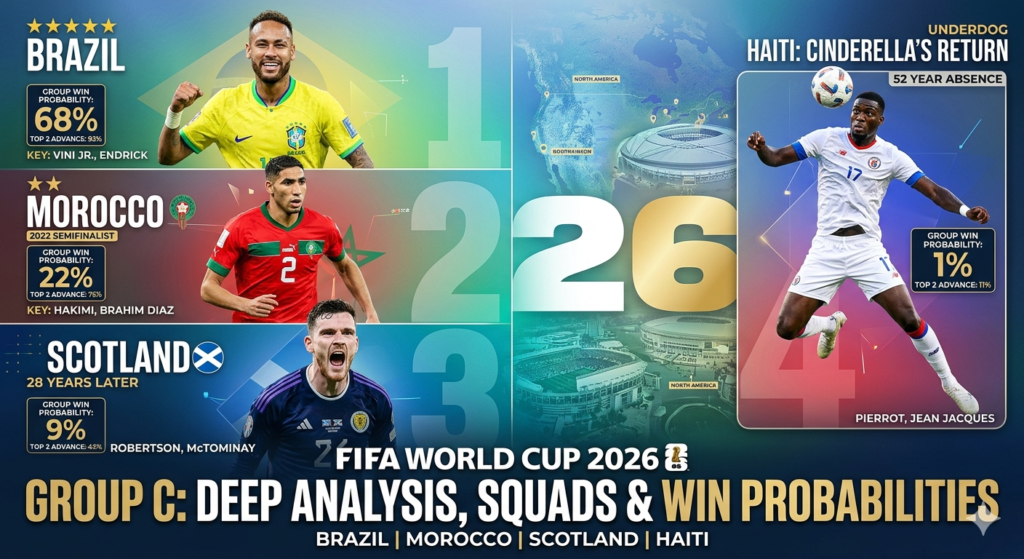
The draw for the 2026 FIFA World Cup has delivered a deeply captivating narrative in Group C. This section brings together a unique blend of historical pedigree, historical breakthroughs, and staggering fairy tales.
Headlining the group is five-time world champions Brazil, looking to shake off a rough CONMEBOL qualifying campaign and end a 24-year trophy drought. They are joined by Morocco, the history-making 2022 semifinalists; Scotland, making their return to the grand stage for the first time since 1998; and Haiti, who qualified for the first time in 52 years, providing the ultimate feel-good underdog story of the tournament.
With all matches played across premier venues in the United States (New York/New Jersey, Boston, Philadelphia, Atlanta, and Miami), Group C promises to be highly competitive. Below is a deep tactical breakdown, squad analysis, and probability assessment.
Group C At A Glance & Projections
| Team | Manager | Core Tactical Identity | Prob. to Win Group | Prob. to Advance (Top 2) |
|---|---|---|---|---|
| Brazil | Carlo Ancelotti | Fluid Joga Bonito possession & high wing-overloads | 55% | 88% |
| Morocco | Mohamed Ouahbi | High-intensity transition & elite defensive compactness | 32% | 72% |
| Scotland | Steve Clarke | Gritty mid-block & direct transitional wing-backs | 11% | 34% |
| Haiti | Sébastien Migné* | Low-block containment & raw counter-attacking speed | 2% | 6% |
Team-by-Team Deep Dive
🇧🇷 Brazil: The Giants Under Pressure
Under the experienced guidance of Carlo Ancelotti, Brazil enters the tournament with heavy scrutiny. Despite a disappointing fifth-place finish in South American qualifying, the Seleção boast a terrifying roster depth that can overpower anyone on their day. Ancelotti has focused on maximizing the staggering individual quality of his wingers while trying to find structural stability in the spine of the pitch.
- Squad Dynamics: Immense attacking wealth paired with a transitional midfield. While Neymar returns to add veteran savvy, the team’s engine relies on younger, explosive European stars.
- Tactical Blueprint: Asymmetric 4-3-3 that heavily isolates fullbacks in 1v1 situations on the wings, balanced by a hard-working double-pivot in midfield to cover the backline.
Three Key Players:
- Vinícius Júnior (Forward, Real Madrid): The undisputed focal point. Coming off excellent club campaigns, his blistering pace, spatial awareness, and clinical finishing make him Brazil’s main weapon.
- Gabriel Magalhães (Defender, Arsenal): The defensive marshal. With aging veterans shifting out, Gabriel’s aerial dominance and elite physical presence are vital to keeping Brazil’s box safe.
- Bruno Guimarães (Midfielder, Newcastle): The midfield tempo-setter. His ball-retention under heavy pressure and vertical progressive passing dictate the flow of Brazil’s transition.
🇲🇦 Morocco: The Continental Elite
Having shocked the world by finishing fourth in Qatar 2022, Morocco enters this group with a target on their back. Now under Mohamed Ouahbi, the Atlas Lions have seamlessly integrated world-class youth prospects with the veteran backbone of their golden generation. They are highly organized, incredibly fit, and lethal when breaking into open space.
- Squad Dynamics: A perfectly balanced team featuring elite fullbacks, hard-pressing central midfielders, and a frontline of clinical, inside-cutting forwards.
- Tactical Blueprint: A rigid, disciplined 4-1-4-1 mid-block that limits central space, forcing opponents into wide traps where elite fullbacks trigger immediate counter-attacks.
Three Key Players:
- Achraf Hakimi (Defender, Paris Saint-Germain): One of the best right-backs in the world. His tireless overlapping runs and creative output provide the tactical heartbeat for Morocco down the right flank.
- Brahim Díaz (Forward, Real Madrid): The creative x-factor. Diaz provides the line-breaking dribbling, flair, and final-third intelligence to unlock stubborn low blocks.
- Sofyan Amrabat (Midfielder, Real Betis): The defensive screen. Amrabat’s immense work rate and physical tackling disrupt opposition creators before they can test the backline.
Scotland: The Resilient Returnees
Steve Clarke has done a masterful job rebuilding Scotland into a robust, modern outfit. Making their first World Cup appearance in nearly three decades, the Tartan Army is under no illusions regarding the quality of their opposition. They make up for a lack of elite flair with extreme structural discipline, high work rate, and an exceptional midfield core.
- Squad Dynamics: Heavily anchored by Premier League experience. While they lack a world-class clinical center-forward, their midfield possesses a surprising goal-scoring threat.
- Tactical Blueprint: A rigid 3-5-2 or 5-4-1 shape that relies on lung-bursting wing-backs to cross into the box, accompanied by late, aggressive runs from central midfielders.
Three Key Players:
- Andy Robertson (Defender, Liverpool): The captain and emotional anchor. His elite crossing, tactical leadership, and defensive tracking down the left side are non-negotiable for Scotland’s system.
- Scott McTominay (Midfielder, Napoli): The clutch goal-scorer. McTominay has an uncanny ability to arrive late into the penalty box, acting as a secondary striker during crossing phases.
- John McGinn (Midfielder, Aston Villa): The midfield engine. His ability to shield the ball under pressure, draw fouls, and transition the team from defense to attack is pivotal.
🇭🇹 Haiti: The Golden Underdogs
Haiti’s qualification is one of the most remarkable stories of the 2026 expansion cycle. Navigating their way through CONCACAF qualifying with immense grit, Les Grenadiers return to the global showpiece exactly 52 years after their lone appearance in 1974. They are massive underdogs on paper, but they play with an unburdened, fearless freedom.
- Squad Dynamics: A roster primarily comprised of players featuring in North American, French, and structural global leagues, leaning heavily on collective unity and raw athleticism.
- Tactical Blueprint: An ultra-compact, deep low block. They concede possession willingly, looking to utilize direct, over-the-top long balls to isolate their speedy forwards against high defensive lines.
Three Key Players:
- Duckens Nazon (Forward, Kayserispor): The experienced talisman. His physical strength and hold-up play are essential for giving Haiti’s defense a breather during heavy spells of pressure.
- Frantzdy Pierrot (Forward, AEK Athens): A towering physical presence up front who serves as the primary target man for direct balls and set-piece opportunities.
- Johny Placide (Goalkeeper, Bastia): The veteran shot-stopper. Facing elite attacks like Brazil and Morocco means Placide will likely need to produce high-volume, heroic saves to keep Haiti in games.
Group C Tactical Verdict
Group C presents an incredibly clear hierarchy, but one that is highly susceptible to tournament variance. Brazil possesses the raw talent to win all three matches comfortably, but if Carlo Ancelotti’s defense shows the same vulnerabilities seen during the qualifiers, a highly disciplined Morocco side is perfectly constructed to punish them on the counter-attack in their opening match.
The pivotal matchup for advancement will likely be Morocco vs. Scotland in Boston. If Steve Clarke’s midfield can frustrate the Atlas Lions and capitalize on a set-piece, Scotland could push for a historic knockout berth. Haiti will provide plenty of heart and structural frustration, but matching the technical speed of this group across 90 minutes will likely prove a bridge too far.
Predicted Order of Finish: 1. Brazil, 2. Morocco, 3. Scotland (On the bubble for best 3rd-place advancement), 4. Haiti.