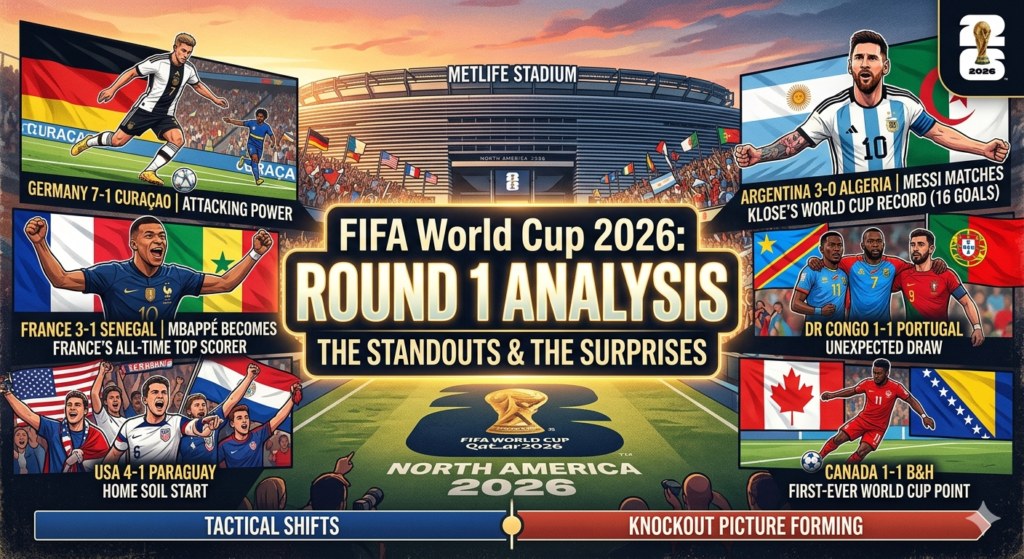
The opening round of the FIFA World Cup 2026 has concluded, providing a fascinating first look at the expanded 48-team format. Across 12 groups, traditional giants made early statements, marquee superstars lived up to the hype, and unheralded underdogs proved that the gap in world football continues to shrink.
Here is an analysis of how the teams performed during the opening block of matches.
The Statement Makers
Several tournament favorites wasted no time asserting their dominance, combining clinical attacking play with maximum points.
- Germany (Group E): The Germans delivered the most ruthless performance of the opening round, dismantling Curaçao 7–1. Their fluidity and overwhelming firepower instantly established them as the most dangerous attacking unit of the early stage.
- Sweden (Group F): Sweden put on a masterclass of efficiency, cruising past Tunisia 5–1 to take comfortable control of their group.
- United States (Group D): Playing on home soil, the USMNT kicked off their campaign with a lively 4–1 victory over Paraguay, showing the kind of high-tempo intensity needed to make a deep tournament run.
- Argentina (Group J): The defending champions looked imperious in a 3–0 win over Algeria, entirely controlling the pitch and suffocating any defensive resistance.
Superstars Live Up to the Hype
The world’s absolute best players arrived in North America in peak form, single-handedly dictating the outcomes of their opening matches.
Round 1 Iconic Performances
- Lionel Messi (Argentina): In a historic sixth World Cup appearance, Messi illuminated Group J with a masterful hat-trick against Algeria, instantly matching Miroslav Klose’s legendary career tally of 16 World Cup goals.
- Kylian Mbappé (France): France overcame a tough Senegal squad 3–1 under the bright lights of MetLife Stadium. Mbappé scored two brilliant second-half goals to break the deadlock, officially becoming France’s all-time leading goalscorer with 58 goals.
- Erling Haaland (Norway): Making his highly anticipated World Cup debut, Haaland powered Norway to a 4–1 victory over Iraq. Scoring twice, he ended Norway’s 28-year tournament absence in dominant fashion.
The Defiant Underdogs
The heavy favorites did not have it all their own way. The expanded format gave several breakthrough nations the ultimate platform to frustrate footballing royalty.
- DR Congo: In one of the round’s biggest surprises, DR Congo went toe-to-toe with Cristiano Ronaldo’s Portugal, fighting resiliently to secure a memorable 1–1 draw in Houston.
- Morocco: Replicating some of their historical defensive grit, Morocco held five-time world champions Brazil to a gritty 1–1 draw in Group C.
- Egypt & Japan: Egypt frustrated a star-studded Belgium side to earn a 1–1 draw, while Japan engaged in a thrilling 2–2 tactical chess match with the Netherlands.
- Canada: The co-hosts celebrated a landmark moment in team history. Trailing early to Bosnia and Herzegovina, substitute Cyle Larin scored an equalizer in the 78th minute to secure a 1–1 result—marking Canada’s first-ever point in a men’s FIFA World Cup.
Tactical Takeaways & The Road Ahead
With 8 of the 12 third-place teams set to advance to the new Round of 32, the first round of matches showed that safety-first tactics might not be enough. While teams like Spain, Uruguay, and Saudi Arabia played out cautious 0–0 stalemates in Group H, the groups that featured aggressive, front-footed play have already created immense separation.
As the tournament moves directly into the second matchday of the group stage, teams who dropped points early face immediate pressure, while the frontrunners are just one victory away from locking in their spots in the knockout rounds.