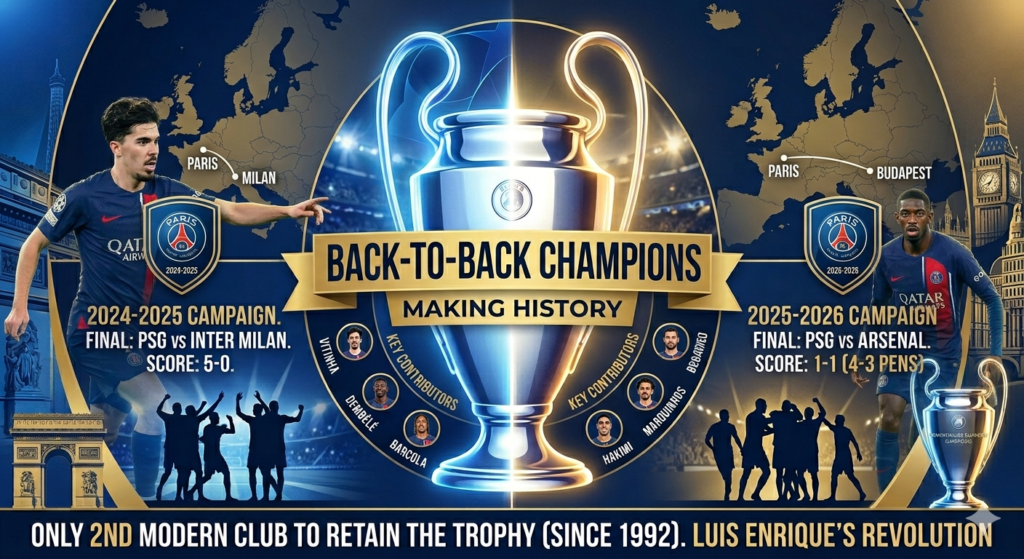
For more than a decade, Paris Saint-Germain’s pursuit of the UEFA Champions League was defined by expensive collapses and star-studded frustrations. Yet, following their spectacular penalty-shootout triumph over Arsenal in Budapest, PSG has achieved what standard European royalty rarely pulls off: they successfully defended their European crown to capture back-to-back Champions League titles.
By adding this triumph to the historic 5-0 demolition of Inter Milan a year prior, PSG becomes only the second club in the modern Champions League era (since 1992) to retain the trophy—joining Zinedine Zidane’s legendary Real Madrid three-peat.
Here is an analysis of how a team once mocked for “choking” transformed into Europe’s most ruthless football collective.
1. The Anti-Superstar Revolution
For years, the blueprint in Paris was simple: buy the biggest names in world football, assemble them on a pitch, and wait for individual magic. It resulted in domestic dominance but structural fragility in Europe.
The turning point came when the club pivoted away from the superstar shortcut. The departures of Lionel Messi, Neymar, and eventually Kylian Mbappé forced a cultural shift. Instead of accommodating individual egos, manager Luis Enrique was given full authority to build a coherent, hard-pressing unit.
2. Dynamic Structural Versatility
Under Luis Enrique, PSG’s tactical identity became fluid, aggressive, and entirely unpredictable. In the final against Arsenal, as well as throughout their knockout encounters with heavyweights like Bayern Munich, PSG deployed a striker-less model built on rapid positional interchanges.
- The Engine Room: Vitinha evolved into one of the world’s premier midfield conductors, pairing elite ball retention with high-intensity pressing.
- The Injection of Youth: Rather than relying on aging mercenaries, the club trusted homegrown and Ligue 1-scoured profiles like Désiré Doué and Bradley Barcola. Their fearlessness brought a direct, swashbuckling energy that broke opponents down in transition.
- Wing Overloads: Utilizing wide threats like Ousmane Dembélé and Khvicha Kvaratskhelia, PSG systematically isolated fullbacks, dragging defensive lines out of shape and creating central voids for late runners.
3. The Blueprint of Champions
The numbers behind their consecutive campaigns reflect a team that has truly cracked the tournament’s DNA.
| Attribute | 2024-2025 Campaign | 2025-2026 Campaign |
|---|---|---|
| Defining Moment | Historic 5-0 demolition of Inter Milan in the final | Coming from a goal down to beat Arsenal on penalties |
| Core Tactical Identity | High-risk, explosive attacking depth | Emotional resilience, game control through aggression |
| Key Direct Contributors | 7 players with 5+ goal involvements | Balanced squad depth across extra time |
The Verdict: Winning one Champions League can happen on momentum; retaining it requires a bulletproof culture. By backing Luis Enrique’s collective ethos over individual marketing power, Paris Saint-Germain didn’t just escape their past—they wrote an entirely new chapter in football history.